
Book Now
Book a free estimate


When shopping for a furnace, you need to check more than just the brand or its warranty. AFUE, or Annual Fuel Utilization Efficiency, is a metric that measures how efficiently a furnace converts fuel to heat. So, a high AFUE rating suggests that the furnace is highly efficient, allowing more heat to enter your home.
Understanding the AFUE rating chart for the Round Rock Heating and Air systems is important to make the right choice for your house.
Before exploring the best annual furnace ratings in Texas, it is ideal to understand how furnaces really work.
To generate heat, a furnace uses a source as fuel. The most common fuel sources are either natural gas or propane. A furnace uses these sources to make its own heat from scratch.
A furnace works by pulling cool air from your home and then passing it over a hot metal chamber called a heat exchanger. This exchanger is warmed by burning natural gas or propane. The heated air produced is then blown back through your ductwork. The exhaust fumes produced are then safely vented outside.
The AFUE rating is the ratio of the furnace’s annual heat output in comparison to its annual energy input.
The U.S. Department of Energy's (DOE) regional standards, as updated under 10 CFR Part 430, have set the minimum efficiency requirements. According to them, Texas falls within the South region. Currently, non-weatherized gas furnaces installed in this region must meet an active minimum efficiency of 80% AFUE. While the DOE finalized updated rules in 2023 targeting higher baseline standards for future compliance, 80% AFUE remains the compliant minimum for Texas installations today.
This baseline percentage fits the region's mild southern climate and low annual heating demand. High-efficiency condensing furnaces often do not yield enough seasonal energy savings to offset their higher equipment and installation costs in warmer regions.
When choosing a system for furnace installation Pflugerville, you can find the AFUE rating displayed on the Energy Guide sticker placed on your unit. You can also check the owner’s manual to find the rating.
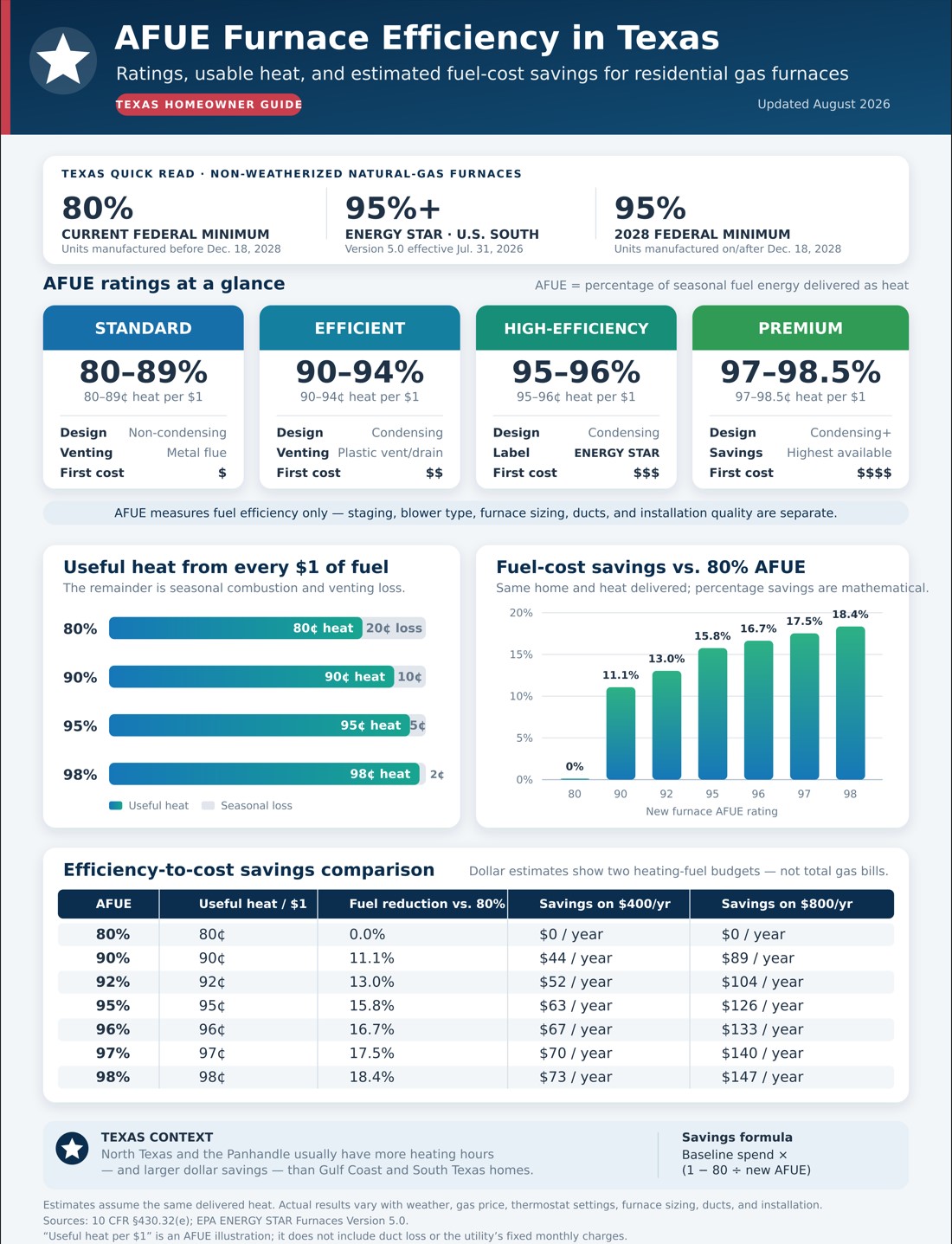
This chart breaks down the real-world fuel cost savings you can expect when upgrading your furnace in Texas. While higher AFUE ratings deliver greater fuel efficiency, annual savings in milder Central and South Texas climates are generally modest, often under $100 per year, due to limited heating hours. However, for homeowners in North Texas or the Panhandle, where winter temperatures drop significantly, choosing a 95%+ condensing unit yields a more substantial return on investment over time.
AFUE measures a system's seasonal thermal efficiency using the standard formula:
AFUE = (Total annual heat output in BTUs / Total annual energy input in BTUs) x 100
Rather than being calculated in the field by local technicians, AFUE ratings are determined through rigorous, standardized laboratory testing mandated by federal procedures (10 CFR Part 430, Subpart B). An 80% AFUE rating means 80% of the fuel consumed is converted into usable heat for your home, while 20% escapes as exhaust gas.
Generally, an 80% AFUE rating is considered standard efficiency. Furnaces with this rating are less efficient than modern models. However, Hutto Heating and Air furnaces with a minimum 80% AFUE are a practical choice in milder temperatures found in Texas.
But it is also wise to understand that the 20% of the lost energy in such furnaces can add up over time, especially in areas with a long heating season.
Furnaces with 90% to 95% AFUE are highly efficient. They are perfect systems for families looking to reduce their utility bills. Systems with AFUE more than 95% provide premium high efficiency.
A good AFUE rating depends on several factors such as:
Consulting a Round Rock Heating and Air expert can help you get your home’s heating needs assessed. They can then recommend the best furnace based on your goals.
An AFUE rating measures fuel conversion under ideal conditions. But in a household environment, there are several interconnected components that determine whether the rating is linked to utility savings in the real world.
You bought a furnace with an 80% AFUE rating. But as long as you don't follow certain preventive measures, it won’t maintain its efficiency for long.
To avoid the latter, you may have to follow certain tips as mentioned below.
Thinking of getting a competent furnace with an ideal AFUE rating for your Texas home? In that case, you may need us to assist you in making a wise decision.
From helping you choose the best furnace with a good AFUE rating to making your home fit enough to maintain it all winter, our experienced technicians can make you feel warm and cozy in the colder months.
Get in touch for your required services!
It depends on heating use, gas prices, installation costs, and available rebates. Because Texas has lower heating demand, payback is usually slower than in northern climates; air sealing, duct sealing, and cooling efficiency may provide better returns. ENERGY STAR classifies Texas in its U.S. South region.
For the same heat output, a 97% furnace uses about 7% less gas than a 90% model. AFUE does not determine whether a furnace is single-stage, two-stage, or modulating; those features must be compared separately. DOE defines AFUE as seasonal output divided by fuel input.
Not necessarily. The theoretical reduction in furnace fuel use is approximately 26%, although total household gas-bill savings may be lower because of weather, water heating, duct losses, and other factors. AFUE is a standardized seasonal rating, not peak efficiency.
Higher AFUE alone does not require larger ducts. If testing reveals excessive static pressure or leakage, modifications may include larger plenums, additional returns, resized ducts, or mastic sealing based on the furnace specifications and ACCA Manual D.
Ideally, both before and after installation. Testing the existing system during estimating can identify needed duct repairs, while final testing confirms that the new furnace operates within the manufacturer’s static-pressure and airflow limits.