

Air conditioning and space heating alone account for 52% of annual energy consumption in a US household. Restoring to ideal thermostat settings not only induces comfort but can also significantly drop your energy consumption, straining your finances in the form of heavy billings and frequent AC repair in Austin, resulting from excessive use.
Read on if you want to figure out how the best thermostat setting can produce a profound impact.
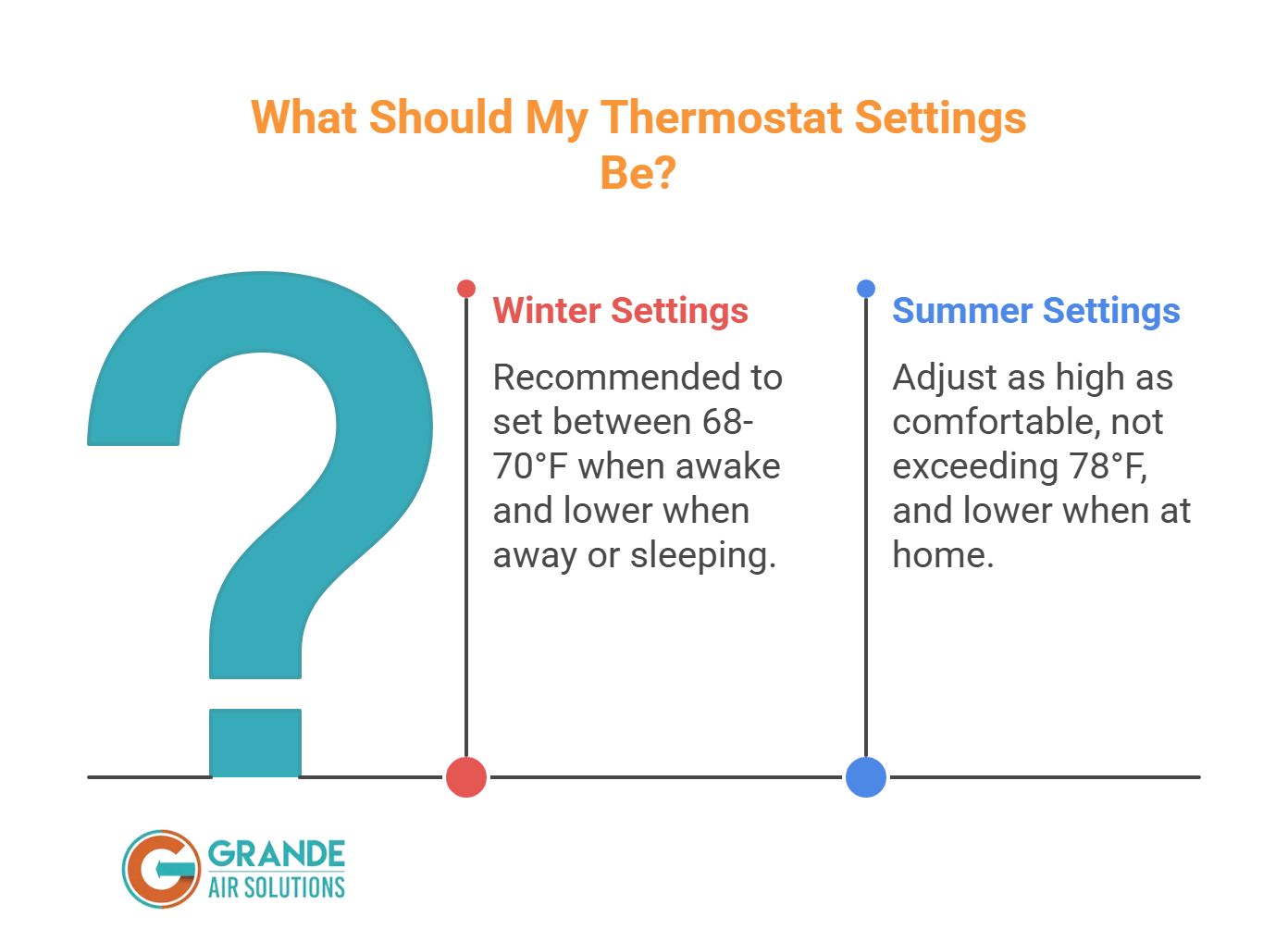
The best thermostat settings for Austin homes in winter are 68-70°F. These settings are recommended when you are awake. Set them to a lower value in case you are away from home or sleeping.
For the summers, the US Department of Energy suggests adjusting the thermostat settings as high as you can tolerate and that you are comfortable with. Alter the settings to a higher value when you are outside and lower them when you are at home and require cooling.
In summer, your thermostat setting shouldn’t exceed 78°F, while in winter the value is to be restricted to 68°F.
Categories | Context | Suggested Temperature | Supporting Information |
Occupancy Status | Occupied | Summer: 78°F | When you’re not using a particular space, you can turn your thermostat settings back by 7-10°F in comparison to your usual settings, as you don’t need that cozy/chilled environment. Doing this for 8 hours will save up to 10% yearly, as indicated by the US Department of Energy. |
Winter: 68°F | |||
Unoccupied | Summer: 85°F | ||
Winter: 60-65°F | |||
Optimal Settings Based on Home Age | Older Homes (Pre-1980) | Summer: 76-78°F Winter: 66-68°F | Older homes were constructed prior to modern standards for insulation. So, issues like poor attic insulation, drafty windows, and leaky ductwork cause greater heat loss in winters and heat gain in summers, demanding frequent HVAC operations to sustain comfort. Slightly lower cooling settings and raise winter settings. |
Newer Homes | Summer: 78°F Winter: 68°F | Improved construction, efficient HVAC system, and high insulation performance lead to prolonged stability of indoor temperatures. So, you can conveniently follow the standard settings. | |
Winter Thermostat Setting for a 2-Story House | Upstairs | 66-68°F | Warmer due to the upward movement of heat, so the setting is slightly lower than usual |
Downstairs | 68-70°F | The lower floor requires more heat, as heat naturally goes upwards, resulting in a rise in thermostat settings. | |
Best Thermostat Settings For a Two-Story House In Summer | Upstairs | 76-78°F | Upstairs becomes hot quickly, requiring a decrease in the thermostat settings |
Downstairs | 78-80°F | Downstairs is usually cooler (hot air rises & cold air sinks to downstairs) and can sustain a rise in thermostat settings |
If your house can’t maintain consistent temperatures even after switching to the above settings, you should consider a professional AC repair in Austin to regain efficiency of your unit.
Summer temperatures are brutal for Texans including those living in Austin. However, running your HVAC 24/7 at lower than necessary temperatures can result in higher utility costs, shorter unit lifespan, and sensitisation of occupants to normal temperatures. So it's crucial your thermostat is optimized with the best settings for comfort and affordability.
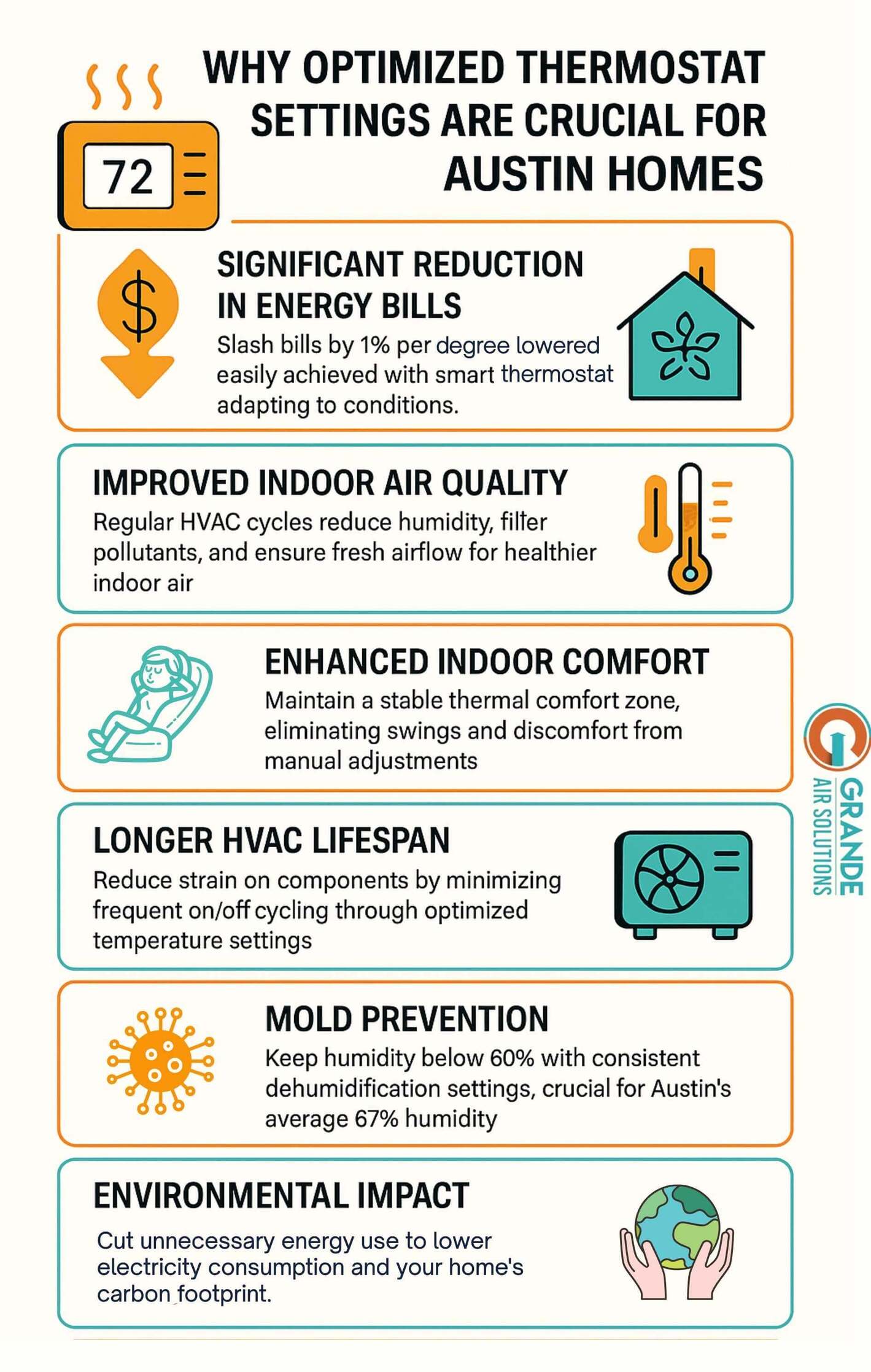
You can cut down 1% on your heating bill every time you lower your thermostat settings by 1°F. Smart or programmable thermostats can automatically adapt indoor temperature by sensing the prevailing circumstances.
Thermostats periodically activate the HVAC system, which significantly improves indoor air quality. HVAC systems decrease humidity and filter out indoor pollutants, reducing their concentration. Moreover, they also provide adequate ventilation, regulate airflow, and eliminate stagnation, thus leading to a fresh indoor environment.
Optimized thermostat settings ensure a stable temperature indoors by avoiding overheating or overcooling. They maintain a thermal comfort zone, reducing the discomfort resulting from temperature swings in case of manual adjustments.
Switching to the best thermostat settings leads to a longer HVAC lifespan. Optimized settings decrease frequent on & off cycling, which disrupts the HVAC components by straining them.
The ideal thermostat settings curb the humidity level below 60% eliminating the risk of mold growth. These settings ensure consistent and thorough dehumidification, saving energy simultaneously. This can be particularly beneficial for humid climates like the one existing in Austin, with an average humidity of 67%.
Modifying your thermostat settings to an optimum level cuts down unnecessary use of energy. This, in turn, reduces electricity consumption, lowering the carbon footprint of your home and combating energy waste.
Optimized thermostat settings can produce a visible difference in maintaining the indoor climate. However, their effectiveness can be enhanced by following the additional strategies listed below. They will allow the thermostat to work more efficiently & accurately.
To avoid heat buildup indoors:
Source: Wikipedia
Vent control and room zoning focus the cooling/heating on occupied areas, thereby reducing the HVAC system load. Energy is saved from being wasted in unused spaces. Resultantly, the thermostat can maintain the temperature at a faster rate and with fewer cycles.
The following thermostat setting mistakes can lead to AC repair in Austin.
The best thermostat settings bring about numerous advantages. However, if you truly want to avail these perks, professional installation and accurate calibration are crucial. Whether you want a thermostat installation or optimization of its settings, Grande Air Solutions has got you covered.
We have an experienced team to offer you expert guidance that you can always rely on. Our tailored solutions will ensure your issues are resolved with no delays. So call (512) 677-4424 today to book our services to leverage our years of expertise!
Set your thermostat to 78°F in summer and 68°F in winter according to Austin Energy guidelines. Raise the temperature to 85°F when you're away in summer to save energy. Use programmable thermostats to maintain efficient cooling and heating schedules.
Set your thermostat in Texas to 78°F in summer and 68°F in winter for optimal energy efficiency. During hot months, increase the setting to 85°F when you're away. In cooler months, lower it when sleeping. Use programmable thermostats to automate savings.
Yes, 72°F is a comfortable heating temperature for winter in Texas, though slightly above the recommended 68°F for energy efficiency. Lowering to 68°F saves money while still maintaining warmth, especially when using layered clothing or blankets.
Yes, setting your AC to 72°F in summer uses more energy and may feel too cold for many people. The Department of Energy recommends 78°F for comfort and efficiency. Lower settings can overwork your unit and increase utility bills.
No, keeping your house at a constant temperature is not cheaper. Adjusting your thermostat based on occupancy and time of day reduces energy use. Use programmable thermostats to lower heat or AC when you're asleep or away to cut costs.
Set your thermostat to 78°F in summer and 68°F in winter to save the most money on energy bills. Raise the temperature when you're away and use ceiling fans to improve comfort. Programmable thermostats help automate energy savings throughout the day.