
Kyle is known for its hot summers, making air conditioners a primary necessity for the residents. The demand for air conditioning will continue to rise as Kyle, TX is experiencing rising temperatures, as the temperature in Texas is expected to rise 1.8 degrees than the 1991-2020 in the next ten years. During hot and humid summers, a bad thermostat can cause different problems, requiring immediate AC repair in Kyle TX. In this detailed guide, we will shed light on some of the signs of a bad thermostat to help you make more informed decisions.
More than 85% of US households relied on air conditioning in 2020, indicating the importance of a functional HVAC system. A broken or bad thermostat not only makes the house uncomfortable by making it unbearably hot or cold, but also leads to energy waste. Furthermore, diagnosing as soon as possible can help lower the cost of the AC repair in Kyle TX. Here are 5 signs you need a thermostat replacement.
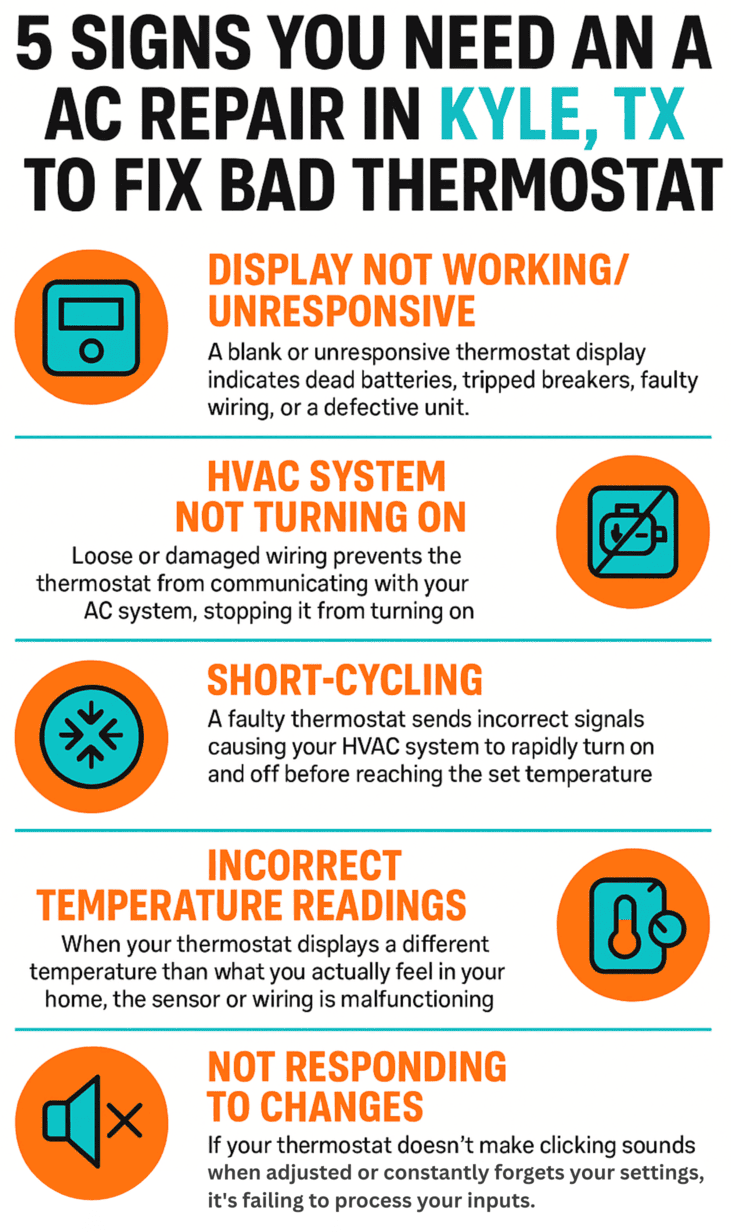
If your thermostat is not displaying anything, there could be a few problems, including:
Possible Issue | How To Check |
Dead batteries | Replace the old batteries with the new ones to see if the display is working |
Tripped Circuit Breaker | Check your electrical panel for tripped breakers and reset it if needed |
Faulty Wiring | Look for damaged or loose wires and tighten it. Call HVAC technician if the wires are damaged |
Defective Thermostat | If nothing else works, replace the thermostat |
If any of these issues persists, you may need a thermostat replacement.
Loose wiring may be behind your AC not working even if the thermostat appears to be fine. It prevents your thermostat from displaying anything or turning on your HVAC system. The purpose of your thermostat is to communicate between you and your air conditioning system. The communication is halted when the HVAC system’s wires loosen over time.
Check your wire connections, including the circuit breaker box. Follow these steps to find out the root cause:
Once you detect the loose wires, tighten the screws and connectors to keep them intact, while ensuring proper safety measures as dealing with electric components is always a risk. However, damaged wires have to be treated delicately as they can cause a short circuit.
A bad thermostat symptom includes repeated cycles of your HVAC system turning off and on rapidly, this is called short-cycling. When a thermostat is bad, it sends incorrect signals to the HVAC system, which causes short-cycling. When the AC stops running before reaching the set temperature, it may seem that the problem is your HVAC, but it can be your damaged thermostat.
You should check if your thermostat is faulty or if you have set really narrow parameters to cause your HVAC system to short cycle. This short-cycling may trigger other issues with the AC including incorrect temperature readings. Addressing the short-cycling issue as soon as possible prevents expensive repairs and replacements later on, which saves money in the long run. Furthermore, it also prevents wear and tear.
A thermostat may display the wrong temperature due to malfunctioning sensor, incorrect placement, or low battery power, dust buildup and incorrect wiring. Your thermostat usually reads the house temperature to heat up or cool down the HVAC system. If you notice that your house has been cooler or hotter than the temperature your thermostat is displaying at that moment, it is a sign that your thermostat is bad.
To confirm if the temperature your thermostat is displaying is incorrect, you can use your smartphone or a more traditional thermometer to measure your house temperature. If the readings differ from one another, call a HVAC technician right away to fix your thermostat.
There are high chances your thermostat is broken if it does not respond to the inputs. You usually hear a whir or a click sound when you adjust the temperature on your thermostat, but if you do not hear the sound, there is some problem.
Also, if you have to constantly reenter the setting, it indicates your thermostat is dying. Many thermostats store the settings and change only when you alter them. Therefore, your thermostat forgetting the settings is an indication that it is dying.
An AC may not run if the thermostat is bad because the thermostat serves as the command center for the cooling system. It sends a signal to the AC unit when indoor temperatures rise above the desired setting. If the thermostat fails due to a wiring issue, dead batteries, calibration errors, or internal faults, it may not trigger the cooling cycle at all.
A malfunctioning thermostat can misread the actual room temperature, causing the AC to run too little, too often, or not at all. In some cases, the screen may go blank or unresponsive, indicating a power supply issue or blown fuse. Even if the AC system itself is in good condition, a faulty thermostat can make it appear as if the unit is broken because it interrupts communication with the compressor and fan.
Diagnosing a thermostat problem involves checking for correct power supply, accurate temperature readings, and ensuring it's correctly matched to the HVAC system. Replacing a bad thermostat can restore full AC function and improve energy efficiency especially when upgrading to a programmable or smart model.
The Texas climate requires consistent cooling as the temperature may rise up to 90 degrees Fahrenheit during peak summer. This humid and hot climate is the reason why Texas homes have higher-than-average electricity consumption due to the needs of air conditioning. When the thermostat goes bad, it can turn your house environment by making it hotter or too cold.
US consumers spend around $10 billion every year on HVAC repair and maintenance, implying that ignoring signs of HVAC repairs including a bad thermostat may cost you a lot of money. Proper diagnosis and prompt repair reduces energy waste and prevents further damage. If your thermostat runs continuously or is short-cycling due to a problem it can put a strain on your HVAC system and shorten its lifespan.
Replacing a thermostat costs between $150 and $500, including parts and labor. Basic models start around $100 installed, while smart thermostats like Google Nest range from $240 to $500. Prices vary based on brand, features, and installation complexity.
If you replace an old manual thermostat with a Google Nest Learning Thermostat (Gen 4), the total cost typically includes $240 for the unit and $100–$150 for professional installation. Total: $340–$390.
Brand | Model | Verified Unit Cost (USD) | Verified Install Cost (USD) | Verified Total Cost (USD) |
Google Nest | Learning Thermostat (4th Gen) | Around $170 | $100–$150 (typical range) | 340–$390 (unit + install) |
ecobee | SmartThermostat | $210 (latest flagship) | $100–$150 (typical range) | $310–$360 |
Honeywell Home | T9 Smart Thermostat | $135–$140 | $90–$140 (typical range) | $225–$280 |
Emerson Sensi | Touch Smart Thermostat | $129 | $90–$130 (typical range) | $220–$260 |
Basic Thermostat | Non-programmable (manual) | $25–$50 | $75–$100 | $100–$150 |
These are just general estimates and not final costs, please contact Grande Air Solutions at (512) 677-4424 to get tailored estimates for your unit.
Grande Air Solutions offers expert thermostat repair, replacement, and smart upgrades as part of our complete AC service in Kyle, TX. Whether your thermostat is malfunctioning, outdated, or incompatible with your HVAC system, our certified technicians will diagnose the issue and install reliable, energy-efficient solutions.
We can also help you upgrade to smart controls like Google Nest or Ecobee to improve comfort and lower energy costs.
So if you’re ready to regain control, maximize comfort, and boost HVAC efficiency which may potentially reduce energy bills as well, contact Grande at (512) 677-4424 to schedule a visit.