
A study conducted in 2020 revealed that 89% of US homes utilized some sort of air conditioning & 67% had a central air conditioning system installed in their homes. It depicts the prevalent use of an AC unit, proving it to be an ultimate necessity, especially in weather like that in Austin. But what if in the scorching heat of a summer day, your AC stops cooling despite the fan running? Let’s dig through this & figure out if you need an emergency AC repair in Austin or not.
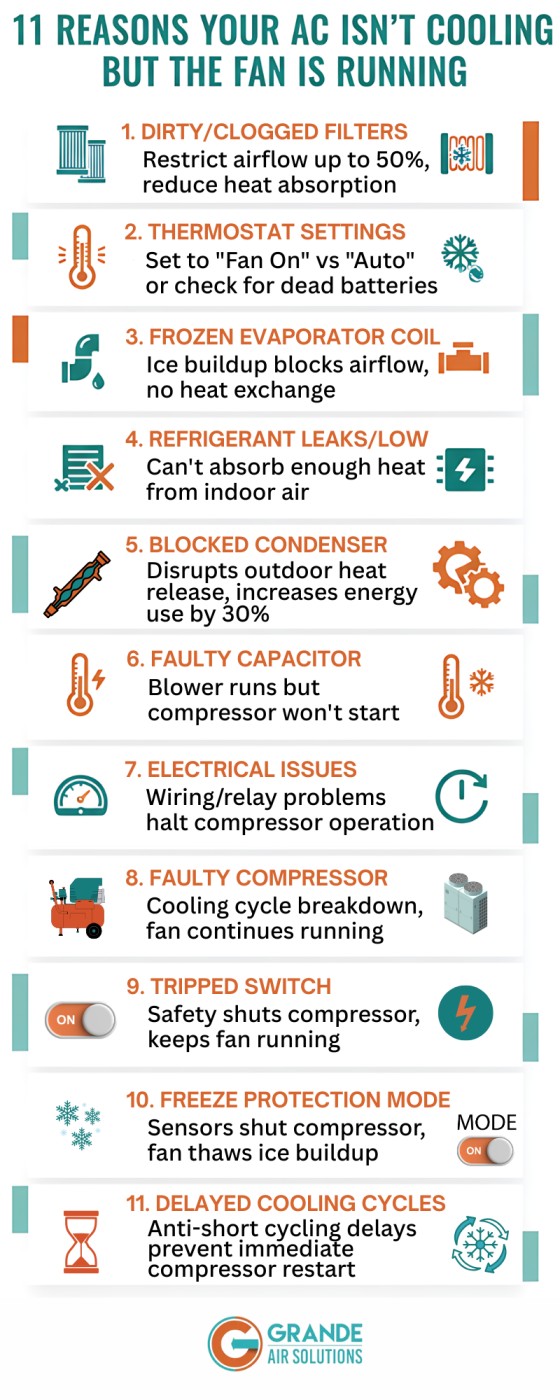
Clogged air filters can be one of the key reasons your AC isn’t cooling even when the fan is running. Air filters packed with debris & pollen restrict the airflow over the evaporator coil. Clogged air filters can obstruct the airflow up to 50%.
The evaporator coil absorbs heat from the warm air circulating over it. Insufficient airflow leads to decreased heat absorption, increasing the likelihood of the evaporator coil becoming frozen and resulting in ineffective cooling.
If your thermostat is set to “Fan On” instead of “Auto”, the blower will continuously circulate air even when the compressor isn’t actively cooling. Likewise, a miscalibrated thermostat, incorrect temperature settings, or dead batteries can inhibit the cooling cycle from starting.
A frozen evaporator coil means that the airflow over it is blocked with no heat exchange, forcing the system to blow warm air. A frozen evaporator coil is the consequence of dirty filters, low refrigerant levels, or blocked vents. The signs of a frozen coil include decreased cooling efficiency, visible ice buildup, and warm air from the vents despite the working of the fan.
Refrigerants absorb heat from indoor air. When there is a refrigerant leak or the refrigerant level drops, the evaporator coil fails to absorb enough heat, which leads to inadequate cooling or even freezing of the coil.
As per the Environmental Protection Agency (EPA), if your AC unit has a charge of 50 Lbs or more and is found to be leaking ozone-depleting refrigerant at a rate greater than 10%, it requires immediate corrective measures.
The condenser unit absorbs heat from inside and releases it to the outdoor air. If it is clogged with dirt, the heat exchange process is disrupted, causing the system to lose its cooling efficiency even when the fan is running. A blocked condenser unit is common in Austin, where high-pollen count, landscape debris, and dust storms are common.
Not only this, a dirty condenser coil additionally increases the energy consumption of the compressor by 30% as per the US Department of Energy (DOE).
If your capacitor is faulty, the blower fan will keep running, but the compressor won’t start, resulting in inadequate cooling.
Modern HVAC systems rely on multiple electrical components, such as wiring, relays, breakers, control boards, etc, to coordinate blower and compressor operation. If any of these components fails, the compressor won’t start, but the blower fan will continue to run, circulating warm air.
In case of a faulty compressor, the fan will run but won’t radiate cool air because the cooling cycle breaks down.
The high-pressure switch is a built-in safety mechanism to protect your AC unit when the refrigerant pressure inside the compressor becomes dangerously high. Once it is triggered, it turns off the compressor to mitigate damage while keeping the blower fan running. Excessive refrigerant pressure can result from blocked airflow, dirty condenser coils, or low refrigerant flow.
If the evaporator coil temperature sensors detect that the temperature of the coil has dropped too low, the control system shuts down the compressor but keeps the fan running to thaw the ice buildup. This is a common scenario that often leads to a fan-only cooling problem.
Some systems have built-in anti-short cycling delays to protect the compressor. If the system enters a protection delay mode or is set to fan-only mode, the compressor won’t restart for several minutes, and the warm air will continue to circulate.
Factors | DIY Fix | Is Professional Help Needed? |
Clogged Filters | Replace every month or after two months | If the coil icing persists & airflow doesn’t improve despite replacing the filter |
Thermostat Misconfiguration | Set on AUTO. For summers, the recommended thermostat settings are 78°C or higher & raise the temperature to 85°C when away from home. Position the thermostat away from sunlight, windows, doorways & skylight to avoid miscalculations in temperature configuration | If the thermostat wiring or sensor is faulty |
Frozen Evaporator Coils | Switch off the AC, allowing the coil to thaw. Clean/replace the filter while ensuring the vents are open. | If the issue persists, seek emergency AC repair in Austin |
Low Refrigerant Level | DIY fixes aren’t feasible | It requires air conditioner repair services from professionals in Austin |
Dirty Outdoor Condenser Unit | Clear the dirt & debris around the unit, maintain 2-3 feet clearance | Yes, if the cooling doesn’t restore despite cleaning. |
Faulty Capacitor | DIY not applicable | Yes |
Electrical Issues | No | Only professionals can safely diagnose & repair |
Faulty Compressor | No | You need to contact an emergency AC repair in Austin |
Tripped High-Pressure Switch | Regulate outdoor airflow, clean condenser coils | Yes, if the switch trips repeatedly |
Having a humid subtropical climate, Austin has an average humidity of 71%. The average temperature in summer can be as high as 97°F. This combination exerts stress on the AC units, drastically decreasing their cooling capacity and causing a scenario where only the fan runs, but with no cooling.
High humidity makes it harder for evaporator coils to get rid of the moisture, leading to reduced cooling output. In addition, extreme heat can also increase refrigerant pressure, triggering safety switches which in turn impact the cooling performance.
Grande Air Solutions has been working for decades, fixing all kinds of HVAC issues including HVAC not cooling even when fans are running. We are a licensed, insured and customer favorite HVAC repair company in Austin and surrounding areas, ensuring you get the best possible solutions for your unit. Call (512) 677-4424 to schedule a visit today!
Yes, it can significantly decrease the efficiency of a cooling system by 20%. Cold air will be lost to the unconditioned spaces, affecting the cooling process.
No, turn it off if you don’t want any further damage and a repair that will drain your finances.
Yes, a faulty compressor can cause your AC to stop cooling while the fan still runs. The compressor circulates refrigerant through the system, and if it fails, the fan may continue blowing but only warm air comes out. Common compressor issues include electrical failure, overheating, or mechanical breakdown.
Low refrigerant levels can make your AC blow warm air while the fan keeps running. Refrigerant absorbs and releases heat, and without enough, the cooling cycle fails. The fan will circulate air, but it won’t be cooled. Signs include ice buildup on coils and hissing or bubbling noises.
Thermostat settings directly affect AC cooling when the fan still runs. If the thermostat is set to “fan only” or the temperature is set higher than room temperature, the fan will circulate air without activating cooling. Correct settings ensure the compressor engages and cold air flows properly.
Call a professional if your AC fan runs but no cold air comes out and you notice warm airflow lasting more than a few hours, ice on coils, unusual noises, or frequent cycling. Persistent issues indicate problems with the compressor, refrigerant, or electrical system that require expert repair.